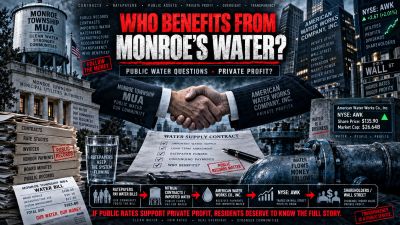
FOLLOW THE WATER. FOLLOW THE MONEY.
WHO BENEFITS FROM MONROE'S WATER?
American Water Works Company, Inc. is a publicly traded corporation listed on the New York Stock Exchange under ticker AWK. As of the latest market close on September 18, 2026, AWK was about $135.90 per share with a market capitalization of approximately $26.64 billion.
American Water Works, Inc
New York Stock Exchange: AWK
$135.90 per share
Market Capitalization: $26.54 Billion
SOURCE: SEC
WHO BENEFITS FROM MONROE'S WATER?
Follow the Water. Follow the Money. Read the Records.
Monroe Township residents deserve to know where their water comes from, where their water payments go, and who ultimately benefits from the money flowing through the system.
The Monroe Municipal Utilities Authority does not obtain all of Monroe's drinking water from its own wells. MTMUA's own November 2025 Safety Manual states plainly that the Authority “imports water from New Jersey American Water through the Borough of Glassboro.”
MTMUA's April 2026 engineering report provides another piece of the trail. It says the Authority has a contract with the Borough of Glassboro to purchase 492,000 gallons of water every day. In 2025, Monroe received 179.58 million gallons from Glassboro, out of approximately 927 million gallons used systemwide, roughly 19% of Monroe's total annual water supply.
And the money is significant. MTMUA's adopted FY2027 budget contains a $780,000 appropriation for “Water Purchases.”
THE DOCUMENTED MONEY TRAIL
Monroe Ratepayers
→ pay water and sewer charges to MTMUA
→ MTMUA budgets $780,000 for purchased water
→ MTMUA has a standing contract to purchase 492,000 gallons per day from Glassboro
→ MTMUA's own emergency/safety plan says that imported water comes from New Jersey American Water through Glassboro
→ New Jersey American Water is part of American Water Works Company, Inc.
→ American Water Works trades publicly as NYSE: AWK
→ AWK earns profits and pays dividends to its shareholders.
That is the chain the public documents establish.
Is Monroe funding Wall Street?
Monroe ratepayer revenue helps fund MTMUA's operations, which include purchasing outside water. MTMUA acknowledges that some of that imported water originates with New Jersey American Water, whose parent company is a publicly traded, investor-owned utility.
American Water describes itself in its SEC filings as the largest publicly traded water and wastewater utility company in the United States, measured by operating revenue and population served. Its regulated businesses generated approximately $4.723 billion in operating revenue in 2025, representing about 92% of the company's total operating revenue. SEC
American Water is also very clear about providing returns to shareholders. Its SEC filing reports that the company paid $633 million in cash dividends during 2025. In July 2026, its board declared another quarterly dividend of $0.895 per share. American Water says its long-term financial targets include 7%–9% annual dividend growth and a dividend payout ratio of approximately 55%–60% of earnings. SEC
That doesn't mean every dollar Monroe pays for imported water becomes shareholder profit. Corporate revenue also pays for employees, treatment, infrastructure, financing, taxes, maintenance and other expenses. But it does mean Monroe is participating in a supply chain that includes an investor-owned utility whose business generates returns for shareholders.
That relationship deserves transparency.
This question goes back at least a decade
The American Water question in Monroe is not new.
Official Monroe Township Council minutes from March 14, 2016 document a lengthy public discussion about the MUA, rates, valuation and possible privatization.
During that meeting, Business Administrator Kevin Heydel acknowledged that the Township had spoken to someone from American Water. He stated that the conversation concerned rates and rate design, not privatization. At that same meeting, Council President Miller stated that the Township was not selling the system to New Jersey American Water.
Other council members raised concerns at the meeting that the contemplated evaluation of the MUA could eventually lead toward privatization or a sale. Those were their expressed concerns, not a finding that a sale was actually underway.
The 2016 record proves there were contacts with American Water and an active public debate about privatization. It does not prove that today's MTMUA is currently being sold to American Water.
Is buying water from a publicly traded company legal?
In itself, yes. New Jersey law gives municipal utilities authorities broad power to enter contracts necessary to provide water and utility services, subject to applicable procurement laws. MTMUA itself states that its purchases are governed by New Jersey's Local Public Contracts Law. NJ.gov
The legal and public-interest questions are therefore not simply, “Is American Water publicly traded?”
The important questions are whether the contracts were properly authorized; whether competitive procurement requirements were followed where applicable; what price Monroe pays; what escalation provisions exist; how long the agreements last; whether alternative water sources were considered; whether conflicts of interest exist; whether the public was adequately informed; and whether any discussions are occurring about a future sale, lease, management contract or privatization of the system.
A sale or transfer of a public water system is something very different from buying bulk water. New Jersey has formal procedures for private acquisitions of public water systems, including regulatory review in applicable cases. NJDEP's Water Infrastructure Protection Act process, for qualifying municipally owned systems, includes financial analysis, public hearings and reviews involving DEP, BPU, DCA and the State Comptroller. The precise procedure for MTMUA would depend upon how any proposed transaction were structured because MTMUA is a separate utilities authority. NJDEP
What is happening now?
MTMUA's own engineer says increasing development is expected to increase Monroe's water demand and recommends investigating additional sources of potable water.
The engineer expressly states that additional Authority-owned production wells would be the preferred solution because they would remain under MTMUA's control without contractual flow requirements. The report also discusses potentially establishing additional interconnections with systems supplied by Aqua New Jersey.
Monroe is growing. Water demand is expected to grow. Monroe already depends partly upon purchased outside water. One source of that imported water is New Jersey American Water through Glassboro. And MTMUA is investigating additional outside water sources for future demand. This is the issue taxpayers and ratepayers should be watching.
The question taxpayers should be asking
As Monroe continues approving developments and water demand grows, will our public water system remain primarily under public control, or will Monroe become increasingly dependent upon investor-owned utilities for one of life's most essential resources?
That question can be investigated with documents instead of speculation.
Source documents
- MTMUA 2025 Safety Manual — states Monroe imports NJ American Water through Glassboro
- MTMUA 2026 Engineering Report — 492,000 gallons/day from Glassboro and future water-supply analysis
- MTMUA FY2027 Adopted Budget — includes $780,000 for water purchases
- MTMUA Financial Disclosures and Budgets
- Monroe Township March 14, 2016 Council Minutes — American Water and privatization discussion
- American Water Works 2025 SEC Form 10-K
- American Water 2026 dividend announcement
- New Jersey Water Infrastructure Protection Act process